Large Raster Zonal Statistics
“Zonal statistics” spans a large range of problems.
This one is inspired by this issue, where a cell areas raster is aggregated over 6 different groupers and summed. Each array involved has a global extent on a 30m grid with shape 560_000 x 1440_000 and chunk size 10_000 x 10_000. Three of the groupers tcl_year, drivers, and tcd_thresholds have a small number of group labels (23, 5, and 7).
The last 3 groupers are GADM level 0, 1, 2 administrative area polygons rasterized to this grid; with 248, 86, and 854 unique labels respectively (arrays adm0, adm1, and adm2). These correspond to country-level, state-level, and county-level administrative boundaries.
Example dataset
Here is a representative version of the dataset (in terms of size and chunk sizes).
import dask.array
import numpy as np
import xarray as xr

from flox.xarray import xarray_reduce

sizes = {"y": 560_000, "x": 1440_000}
chunksizes = {"y": 10_000, "x": 10_000}
dims = ("y", "x")
shape = tuple(sizes[d] for d in dims)
chunks = tuple(chunksizes[d] for d in dims)

ds = xr.Dataset(
    {
        "areas": (dims, dask.array.ones(shape, chunks=chunks, dtype=np.float32)),
        "tcl_year": (
            dims,
            1 + dask.array.zeros(shape, chunks=chunks, dtype=np.float32),
        ),
        "drivers": (dims, 2 + dask.array.zeros(shape, chunks=chunks, dtype=np.float32)),
        "tcd_thresholds": (
            dims,
            3 + dask.array.zeros(shape, chunks=chunks, dtype=np.float32),
        ),
        "adm0": (dims, 4 + dask.array.ones(shape, chunks=chunks, dtype=np.float32)),
        "adm1": (dims, 5 + dask.array.zeros(shape, chunks=chunks, dtype=np.float32)),
        "adm2": (dims, 6 + dask.array.zeros(shape, chunks=chunks, dtype=np.float32)),
    }
)
ds
<xarray.Dataset> Size: 23TB
Dimensions:         (y: 560000, x: 1440000)
Dimensions without coordinates: y, x
Data variables:
    areas           (y, x) float32 3TB dask.array<chunksize=(10000, 10000), meta=np.ndarray>
    tcl_year        (y, x) float32 3TB dask.array<chunksize=(10000, 10000), meta=np.ndarray>
    drivers         (y, x) float32 3TB dask.array<chunksize=(10000, 10000), meta=np.ndarray>
    tcd_thresholds  (y, x) float32 3TB dask.array<chunksize=(10000, 10000), meta=np.ndarray>
    adm0            (y, x) float32 3TB dask.array<chunksize=(10000, 10000), meta=np.ndarray>
    adm1            (y, x) float32 3TB dask.array<chunksize=(10000, 10000), meta=np.ndarray>
adm2 (y, x) float32 3TB dask.array<chunksize=(10000, 10000), meta=np.ndarray>Zonal Statistics
Next define the grouper arrays and expected group labels
result = xarray_reduce(
    ds.areas,
    *by,
    expected_groups=expected_groups,
    func="sum",
)
result
<xarray.DataArray 'areas' (tcl_year: 23, drivers: 5, tcd_thresholds: 7,
                           adm0: 248, adm1: 86, adm2: 854)> Size: 59GB
dask.array<reshape, shape=(23, 5, 7, 248, 86, 854), dtype=float32, chunksize=(23, 5, 7, 248, 86, 854), chunktype=numpy.ndarray>
Coordinates:
  * tcl_year        (tcl_year) int64 184B 0 1 2 3 4 5 6 ... 16 17 18 19 20 21 22
  * drivers         (drivers) int64 40B 1 2 3 4 5
  * tcd_thresholds  (tcd_thresholds) int64 56B 1 2 3 4 5 6 7
  * adm0            (adm0) int64 2kB 0 1 2 3 4 5 6 ... 242 243 244 245 246 247
  * adm1            (adm1) int64 688B 0 1 2 3 4 5 6 7 ... 79 80 81 82 83 84 85
* adm2 (adm2) int64 7kB 0 1 2 3 4 5 6 ... 848 849 850 851 852 853Formulating the three admin levels as orthogonal dimensions is quite wasteful — not all countries have 86 states or 854 counties per state. The total number of GADM geometries for levels 0, 1, and 2 is ~48,000 which is much smaller than 23 x 5 x 7 x 248 x 86 x 854 = 14_662_360_160.
We end up with one humoungous 56GB chunk, that is mostly empty (sparsity ~ 48,000/14_662_360_160 ~ 0.2%).
We can do better using a sparse array
Since the results are very sparse, we can instruct flox to construct dense arrays of intermediate results on the full 23 x 5 x 7 x 248 x 86 x 854 output grid.
ReindexStrategy(
    # do not reindex to the full output grid at the blockwise aggregation stage
    blockwise=False,
    # when combining intermediate results after blockwise aggregation, reindex to the
    # common grid using a sparse.COO array type
    array_type=ReindexArrayType.SPARSE_COO
)
from flox import ReindexArrayType, ReindexStrategy

result = xarray_reduce(
    ds.areas,
    *by,
    expected_groups=expected_groups,
    func="sum",
    reindex=ReindexStrategy(
        blockwise=False,
        array_type=ReindexArrayType.SPARSE_COO,
    ),
    fill_value=0,
)
result
<xarray.DataArray 'areas' (tcl_year: 23, drivers: 5, tcd_thresholds: 7,
                           adm0: 248, adm1: 86, adm2: 854)> Size: 59GB
dask.array<reshape, shape=(23, 5, 7, 248, 86, 854), dtype=float32, chunksize=(23, 5, 7, 248, 86, 854), chunktype=sparse.COO>
Coordinates:
  * tcl_year        (tcl_year) int64 184B 0 1 2 3 4 5 6 ... 16 17 18 19 20 21 22
  * drivers         (drivers) int64 40B 1 2 3 4 5
  * tcd_thresholds  (tcd_thresholds) int64 56B 1 2 3 4 5 6 7
  * adm0            (adm0) int64 2kB 0 1 2 3 4 5 6 ... 242 243 244 245 246 247
  * adm1            (adm1) int64 688B 0 1 2 3 4 5 6 7 ... 79 80 81 82 83 84 85
* adm2 (adm2) int64 7kB 0 1 2 3 4 5 6 ... 848 849 850 851 852 853The output is a sparse array (see the Data type section)! Note that the size of this array cannot be estimated without computing it.
The computation runs smoothly with low memory.
Why
To understand why you might do this, here is how flox runs reductions. In the images below, the areas array on the left has 5 2D chunks. Each color represents a group, each square represents a value of the array; clearly there are different groups in each chunk.
reindex = True
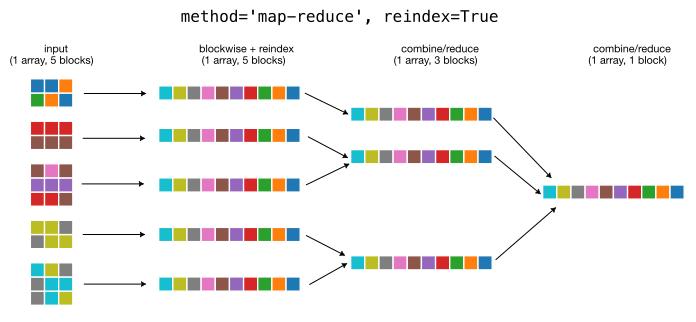
First, the grouped-reduction is run on each chunk independently, and the results are constructed as dense arrays on the full 23 x 5 x 7 x 248 x 86 x 854 output grid. This means that every chunk balloons to ~50GB. This method cannot work well.
reindex = False with sparse intermediates
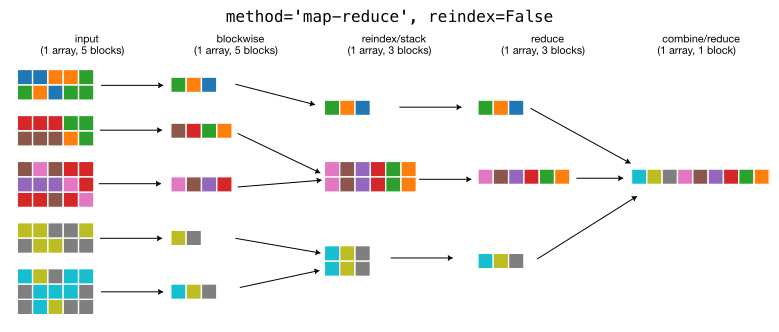
First, the grouped-reduction is run on each chunk independently. Conceptually the result after this step is an array with differently sized chunks.
Next results from neighbouring blocks are concatenated and a reduction is run again. These results are first aligned or reindexed to a common grid of group labels, termed “reindexing”. At this stage, we instruct flox to construct a sparse array during reindexing, otherwise we will eventually end up constructing dense reindexed arrays of shape 23 x 5 x 7 x 248 x 86 x 854.
Can we do better?
Yes.
Using the reindexing machinery to convert intermediates to sparse is a little bit hacky. A better option would be to aggregate directly to sparse arrays, potentially using a new
engine="sparse"(issue).The total number of GADM geometries for levels 0, 1, and 2 is ~48,000. A much more sensible solution would be to allow grouping by these geometries directly. This would allow us to be smart about the reduction, by exploiting the ideas underlying the
method="cohorts"strategy.
Regardless, the ability to do such reindexing allows flox to scale to much larger grouper arrays than previously possible.